Agent Architecture Is a Safety Control When Tool Density Becomes Risk
More agents and more tools do not just change performance. They change blast radius, error amplification, and what must be controlled.
Article focus
Treatment: photo
Prompt family: BA-3 (high)
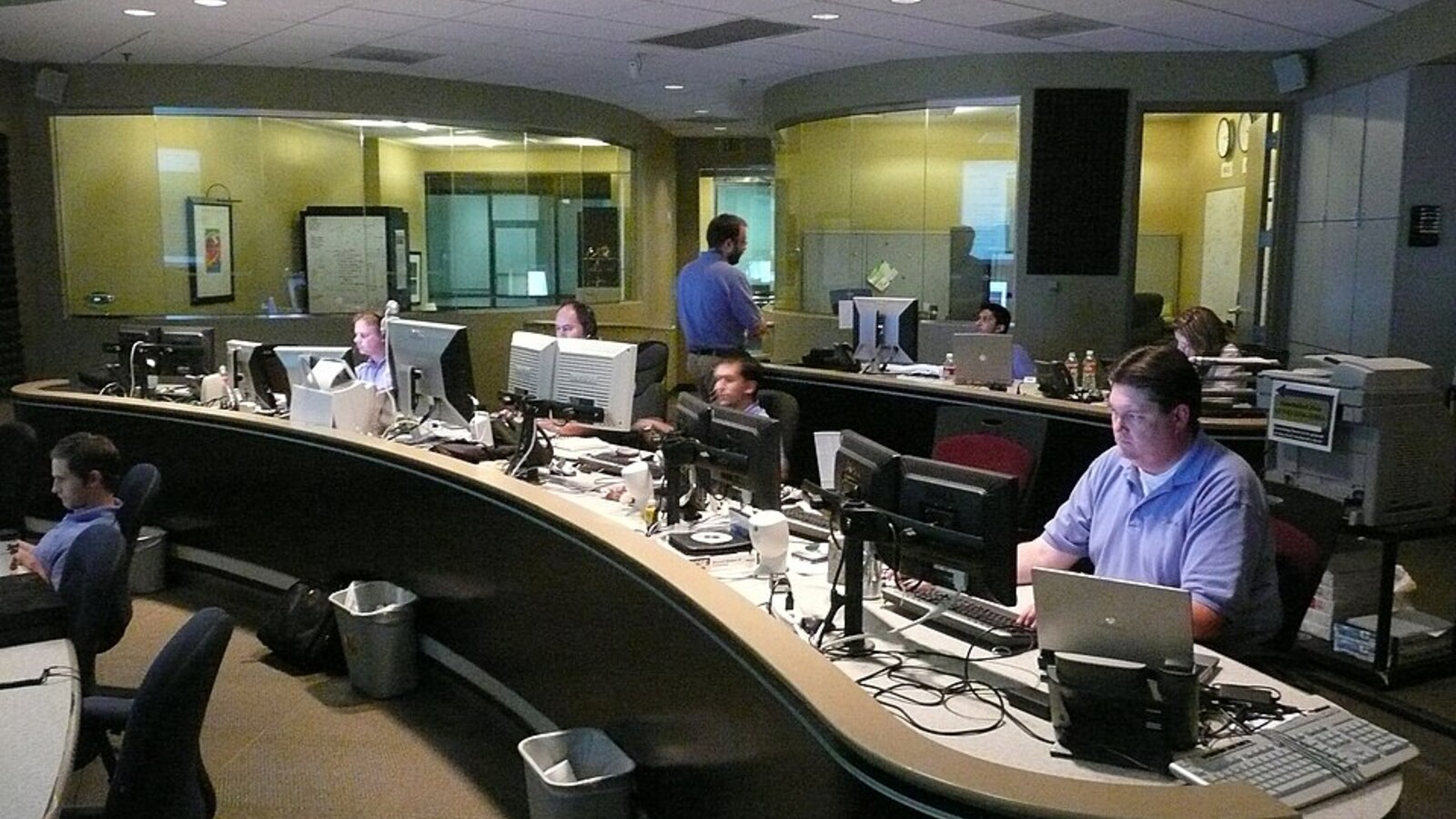
Image description: Network operations center with multiple operators at monitoring desks, representing agent control architecture
Image source: Architel via Wikimedia Commons
License: CC BY 2.0
Executive summary
The newest agent-scaling research reinforces a security point enterprises often miss: orchestration topology is not just a performance choice. It determines where validation happens, how tool calls fan out, and whether one bad judgment becomes a contained mistake or a cross-system incident.
Topology evidence from agent-scaling research
Agent architecture is a security boundary because it defines who can act, who can delegate, and who gets the final say before a tool runs. A single-agent loop concentrates reasoning and action in one place. A planner-worker design fragments that path across handoffs. A peer mesh adds direct agent-to-agent communication, which can increase reach before any human notices the state change.
The recent Google Research post, and the underlying paper it summarizes, evaluate canonical agent topologies and show that architecture and task shape jointly determine both performance and reliability. The security implication is straightforward: if topology changes how errors propagate, it also changes blast radius. A bad subtask decomposition, stale summary, or over-broad delegation path can spread across the workflow even when no adversary has found an exploit.
What changes before an exploit exists
- More delegation: one planner can trigger several workers and multiply the number of external actions.
- More shared state: summaries, memory, and intermediate outputs become trust boundaries.
- More message paths: every handoff is another place for stale, partial, or incorrect context to survive.
- More possible side effects: the same reasoning mistake can touch more tools, files, and services in one run.
How tool density amplifies error and approval fatigue
Tool density changes the economics of mistakes. A model that can only answer in text has a narrow failure mode. A model that can call shell, browser, ticketing, CI, cloud, and data tools has many more ways to turn a weak judgment into a durable change. As workflows become more tool-heavy, the coordination tax rises. In security terms, more connectors create more opportunities to issue the wrong action, request another approval, or normalize unsafe escalation.
This is why approval fatigue is not separate from architecture. A dense tool graph creates more prompts, more delegated tool requests, and more exceptions to review. Teams stop evaluating each step as a security decision and start treating approvals as routing noise. That is how a harmless-looking agent chain becomes operational risk even without malware, prompt injection, or a compromised dependency.
Where validation bottlenecks appear in agent chains
Validation bottlenecks are the points where an architecture can catch bad state before it propagates. In the Google Research findings, centralized systems showed better error containment than independent swarms. One plausible reason is that an orchestrator creates a synthesis checkpoint before downstream action. That bottleneck is not just a performance feature. It is a control surface.
High-risk boundaries to validate explicitly
- Planner to worker: does the subtask preserve constraints, or did the planner drop safety context?
- Worker to tool: is the requested action within policy, or just plausible in context?
- Tool to memory: are outputs treated as verified facts or as untrusted evidence that still needs checking?
- Reviewer to execution: is approval deterministic and policy-based, or a human click-through habit?
When delegation becomes policy: organizational consequences
Safer architecture does not mean fewer agents at all costs. It means matching topology to the work and making control boundaries explicit. Use isolated workers for high-risk actions. Keep credentials and tool scopes narrow. Require deterministic validation before state changes, not after. Preserve action-level visibility so reviewers can inspect what an agent actually attempted instead of trusting a polished recap.
Architecture is company policy when it decides what context and authority can be delegated before tools run. If teams cannot enforce that boundary, orchestration choices quietly become permission decisions.
Practical safeguards
- Isolate execution roles: planning, execution, and review should not all share the same permissions.
- Scope tools per task: give each agent only the connector and environment access it must have.
- Enforce deterministic checks: validate arguments, destinations, and policy before tool execution.
- Add review checkpoints: require human or policy review at state-changing boundaries, not everywhere.
- Log action lineage: keep visibility into which agent proposed, approved, and executed each action.
Security teams often look for the classic exploit: prompt injection, credential theft, remote code execution, or a poisoned tool. Those matter. But multi-agent systems can outgrow their security boundary before any of those events occur. More agents, more tools, and weaker validation paths are enough to expand blast radius on their own.
3LS controls for tool-dense, multi-agent workflows
3LS helps teams keep that expansion under control with sandboxing, approval policy, and action-level visibility tied to the system architecture itself. That is the right control model for agent systems that delegate, coordinate, and act across real enterprise environments.
Next action: map your tool graph to explicit validation gates
Pick one real workflow that uses multiple tools, then trace the delegation path end to end: planner, workers, tools, memory writes, and approvals. For each boundary, define at least one deterministic check that must pass before the next step can execute, and scope permissions so a failed check cannot be bypassed by "trying another tool." This turns topology into an enforceable control plan instead of an architectural preference.
Continue reading